Measure AI Visibility 2026: KPIs, Dashboard & Your Own Data
Measuring AI visibility means systematically and repeatably checking whether ChatGPT, Claude, Gemini, or Perplexity mention your brand in their answers - not a random one-off sample. This article shows the three KPIs that actually matter, with real screenshots from our own dashboard - and the step most guides on this topic skip entirely: connecting visibility to actual leads.
Why this matters right now
37% of consumers now start their search with an AI instead of Google, and among B2B software buyers, one in two (51%) now starts research with an AI chatbot instead of a traditional search engine - up from just 29% in April 2025. Among Gen Z, 82% have already used AI chatbots, compared to 68% of millennials.
Important context: Google still handles roughly 90% of global search traffic - AI search isn't (yet) replacing traditional search, it's growing alongside it as a parallel channel. Still, the growth rate is notable: AI traffic to websites grew 16x from 2024 to 2026, and traffic from Claude alone grew 320% from 2025 to 2026.
Sources: Position Digital, AI SEO Statistics 2026, Orbit Media, AI-Search Adoption Survey, The Stacc, AI Search Referral Traffic Statistics 2026.
The 3 KPIs that actually matter
Most guides on this topic list five, six, or more KPIs - presence rate, topic coverage, stability rate, and so on. In practice, it comes down to three questions that actually trigger action:
| KPI | What it shows |
|---|---|
| Mention rate | Share of checked queries where the brand is mentioned at all - the baseline metric. |
| Recommendation context (sentiment) | Is the brand actively recommended, just mentioned neutrally, or shown worse than competitors in a comparison? |
| Lead source | How many of your actual website visitors and conversions provably come from an AI source - the metric that connects visibility to business outcome. |
The third KPI - lead source - is missing from most guides on this topic, mostly because most pure visibility tools simply can't measure it. More on that below.
How to measure it, step by step
Using our own dashboard as the example - the flow is similar across most GEO tools, the specific screenshots are from Scanora:
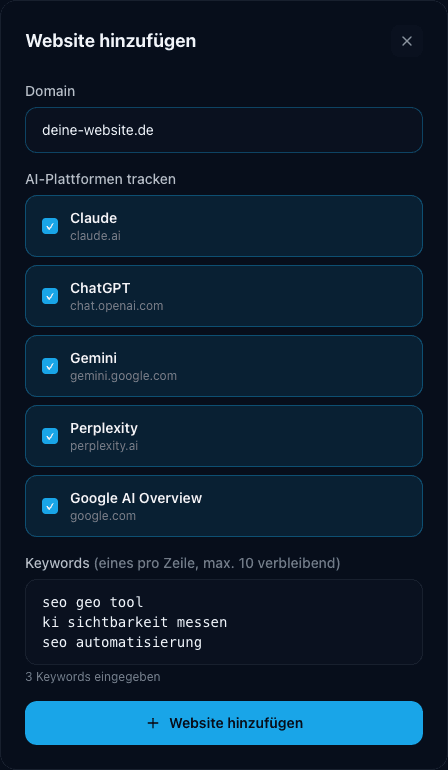
Add your website, pick platforms, set your first keywords
Add the domain, select AI platforms (including Gemini), and set the first topics/keywords right away.
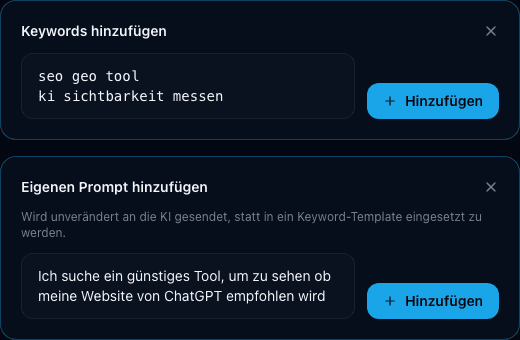
Add more keywords or custom prompts later
Two paths: ready-made keywords (inserted into a prompt template) or a fully custom, freely written prompt - e.g. the exact question a real customer would ask.
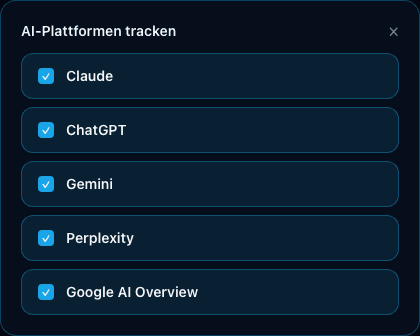
Configure platforms in detail
Each website lets you toggle which AI platforms are actively checked - including Gemini.
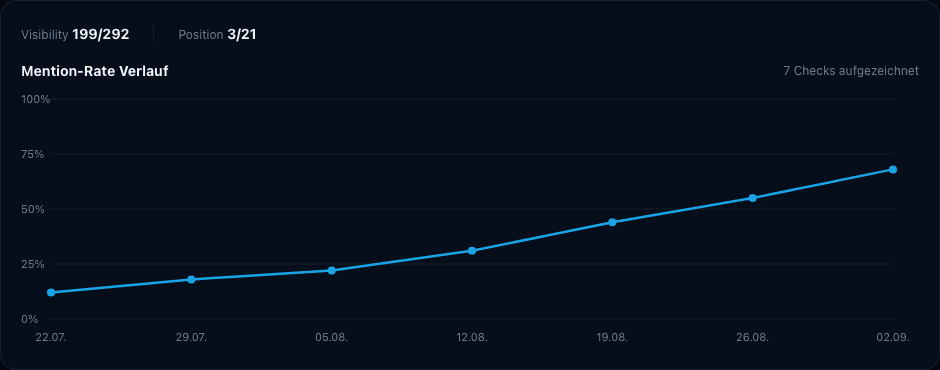
Evaluate mention rate over time
A single measurement is a snapshot. The trend across multiple checks shows whether visibility is actually changing.
The missing step: from visibility to real leads
Almost every guide on this topic stops at mention rate. The problem: a high mention rate says nothing about whether it actually turns into real visitors or customers. And this is exactly where real numbers matter: AI traffic demonstrably converts better than classic organic search traffic - ChatGPT referral traffic converts at around 15.9%, Perplexity at 10.5%, Claude at 5.0% - in some cases 4.4x to 23x higher than the average organic search visitor.
That's why, on top of pure visibility tracking, Scanora built lead attribution: a tracking snippet detects whether a visitor arrives from ChatGPT, Claude, Perplexity, or Gemini, and links that to the AI source when they convert (e.g. a contact form) - only with cookie consent. That answers what pure visibility numbers can't: not just "am I mentioned", but "does it actually bring me leads".
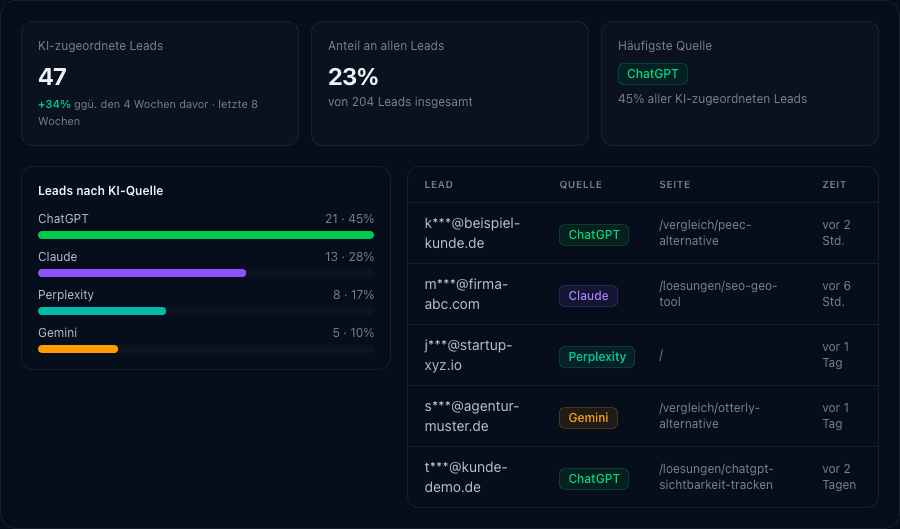
Transparency: the lead-tracking feature is new, and we don't yet have a meaningful volume of aggregated customer data to show - the screenshot deliberately shows demo data, not real customer numbers. The cited conversion rates come from independent industry studies, not from Scanora's own data.
Conversion rate source: The Stacc, AI Search Referral Traffic Statistics 2026.
Keep an eye on competitors: who AI models recommend instead
Your own mention rate is only half the answer. Just as important: which other domains AI models cite instead when they don't mention you. Only the comparison reveals whether weak visibility is on you, or because a competitor is simply more dominant in that specific topic.
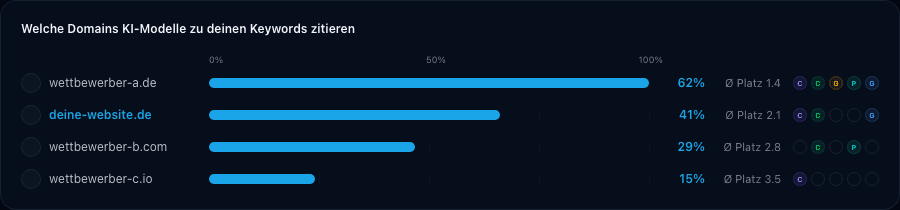
In practice: if the data shows a competitor gets cited across all 5 platforms and you only show up on 2-3, that's a concrete target - not "get more visible somehow", but "catch up on the platforms you're missing". If instead nobody in your space gets cited reliably, the whole topic is underserved - an opportunity to become the go-to source first.
How to get mentioned and recommended - and reach #1
Measuring shows where you stand today. These five levers move the needle the most in practice - roughly in the order they tend to kick in first:
1. Allow AI crawlers technically
GPTBot, ClaudeBot, PerplexityBot, and friends need to actually be allowed to crawl via robots.txt - a blocker that sounds trivial but is surprisingly common. An llms.txt adds an explicit, structured summary for AI systems on top of that.
2. Provide clear, citable definitions
AI models prefer to extract short, unambiguous sentences right after a heading ("X is ..."), not vague marketing paragraphs. If you don't supply your own definition as a quotable sentence, you leave the wording to the AI - and to chance.
3. Set up schema markup correctly
Organization, FAQPage, and Article schema give AI systems structured facts instead of forcing them to guess from body copy - especially relevant for pricing, authorship, and freshness.
4. Show up in third-party sources AI already cites
Claude and Perplexity mostly cite established third-party sources (comparison sites, industry articles, directories), not just your own domain. A mention on a page AI already cites often outweighs another piece of content on your own site.
5. Re-measure regularly instead of optimizing once
AI answers change with every model update. "#1" on an AI isn't a fixed state like a Google ranking - it has to be re-earned weekly, which is exactly why continuous measurement (see above) matters more than a one-time optimization push.
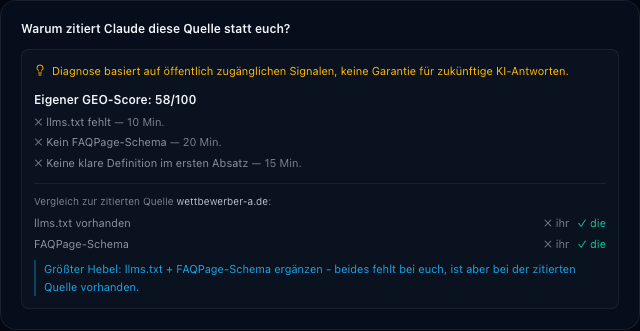
Instead of guessing which of these five levers applies to you, Scanora shows, per keyword, exactly what's missing - directly compared to the source an AI actually cites:
A deeper walkthrough of the 4 levels of AI visibility: AI Visibility: How to Get Cited by ChatGPT, Claude & Perplexity.
Without a tool: measuring manually
If you want to start without a tool: build a spreadsheet with 15-20 realistic questions, enter each one individually into ChatGPT, Claude, Perplexity, and Gemini (in incognito mode, to avoid personalized results), and note for each answer whether and how the brand is mentioned. The downside: this is hard to repeat weekly without becoming a part-time job - and lead attribution isn't possible this way at all, since that requires a tracking snippet on your own website.
Frequently asked questions
What does it mean to measure AI visibility?
Measuring AI visibility means systematically and repeatably checking whether ChatGPT, Claude, Gemini, or Perplexity mention your brand in their answers - as opposed to a random, one-off sample.
How often should I measure AI visibility?
At least weekly, using the same prompts each time so results stay comparable over time. AI answers vary from request to request - a single measurement only shows a snapshot, not a reliable picture.
Is AI visibility the same as SEO?
No, but the two are related. SEO measures your position in classic Google search results. AI visibility measures whether an AI mentions you in a generated answer - independent of any ranking number. A page can rank well on Google and still be invisible to ChatGPT, or the other way around.
Can I measure AI visibility for free?
Yes, a one-off check is possible without sign-up or a credit card. Ongoing, weekly tracking across multiple platforms usually requires a paid plan, since every automated check has real API costs with the AI providers.
How do I know if an AI citation actually leads to a real lead?
Pure visibility tools cannot answer that - they only show whether you are mentioned, not what happens afterward. That requires lead attribution: a visitor who arrives from ChatGPT, Claude, Perplexity, or Gemini gets linked to that AI source at the moment they convert (e.g. fill out a form), instead of showing up as anonymous traffic.
How do I get my website to rank #1 on ChatGPT, Claude & co.?
Five levers matter most: allow AI crawlers like GPTBot and ClaudeBot technically, provide clear, citable definition sentences right after headings, set up correct schema markup, get mentioned in third-party sources AI already cites, and measure regularly instead of optimizing once. Unlike a Google ranking, "#1" on an AI is not a fixed state - it shifts with every model update.
Measure your own AI visibility for free
Enter your URL and get your first GEO score in about 60 seconds - no sign-up, no credit card.
AI visibility: the next steps
Measuring shows where you stand. This article shows exactly what to do to get cited more often.
Scanora vs. other AI visibility tools
See how Scanora compares to Peec.ai, Otterly.ai, Writesonic, and Rankscale on price and features.